
If You Started Again Today, Would You Do Everything The Same?
| 5 Min Read |
Complexity Doesn’t Happen Overnight
If you started your organisation again today, there’s a good chance some of your processes, workflows, and systems would look very different.
Not because they’re wrong, but because organisations evolve. Technology advances, operational requirements change, and newer solutions emerge.
In reality, most operational complexity develops gradually. Organisations grow, regulations change, technology advances, and teams introduce new ways of solving problems.
Many organisations rely on legacy processes because:
- They were the best solution at the time
- Replacing them takes a lot of effort
- Teams have adapted to the workflows
- Risks of changing outweigh the benefits
- They ‘work’ just fine
- Nobody has stopped to ask whether there is a better way
A system that was effective five years ago may not be the best option today. A regular healthcare system review helps organisations identify opportunities for improvement before inefficiencies become embedded in daily operations.
The Hidden Cost of “We’ve Always Done It This Way”
Legacy systems often continue to perform their intended function. The challenge is that organisations can become so familiar with existing processes that they stop questioning whether there is a more efficient way of working.
Over time, small inefficiencies often become part of everyday work. For example, additional manual processes or workarounds may only add a few minutes to a task. However, when repeated across teams and departments, those minutes quickly accumulate.
This is particularly important in healthcare environments, where time is the most valuable resource. Research suggests healthcare professionals spend approximately 15 hours each week on paperwork, referrals, inbox management, transfers, and compliance-related administration. With healthcare staff spending so much time each week on admin, refining the systems they rely on becomes integral to saving time.
This further emphasises that the biggest operational costs are often hidden within everyday processes rather than large projects or major investments. They usually stem from small inefficiencies that become accepted as part of routine work.
15 Hours
Average time healthcare professionals spend each week on administrative work
Source – nsp.co.nz
How to Assess Whether Your Systems Are Still Working For You With a Healthcare System Review
Identifying inefficiencies becomes more difficult when teams use the same systems every day. As teams become familiar with existing ways of working, workarounds and additional administrative steps can gradually become accepted as normal.
Therefore, conducting a regular healthcare system review is essential. Doing so helps providers identify opportunities to improve efficiency and reduce unnecessary administrative burden.
Signs it may be time to reassess your systems:
- Staff relying on workarounds to complete tasks
- Information needing to be entered in multiple places
- Reporting processes require significant manual effort
- Teams spend considerable time moving between systems
- Existing workflows have not been reviewed for considerable time
- New systems have been added without replacing older processes
The goal is not to replace systems simply because they are old. Instead, organisations should ensure their systems continue supporting efficiency, visibility, and day-to-day operations.
In addition, regular system reviews help organisations simplify operations, remove unnecessary steps, and ensure technology continues to support frontline teams effectively. Consequently, even small improvements can create meaningful benefits when applied across an organisation, allowing staff to spend more time focused on care and less time navigating inefficient processes.
Why Ongoing System Reviews Matter
Healthcare organisations operate in an environment of constant change. Regulatory requirements evolve, workforce expectations shift, and technology continues to advance.
Regular healthcare system reviews help organisations identify opportunities for improvement early. As a result, teams can address inefficiencies before they become part of everyday operations.
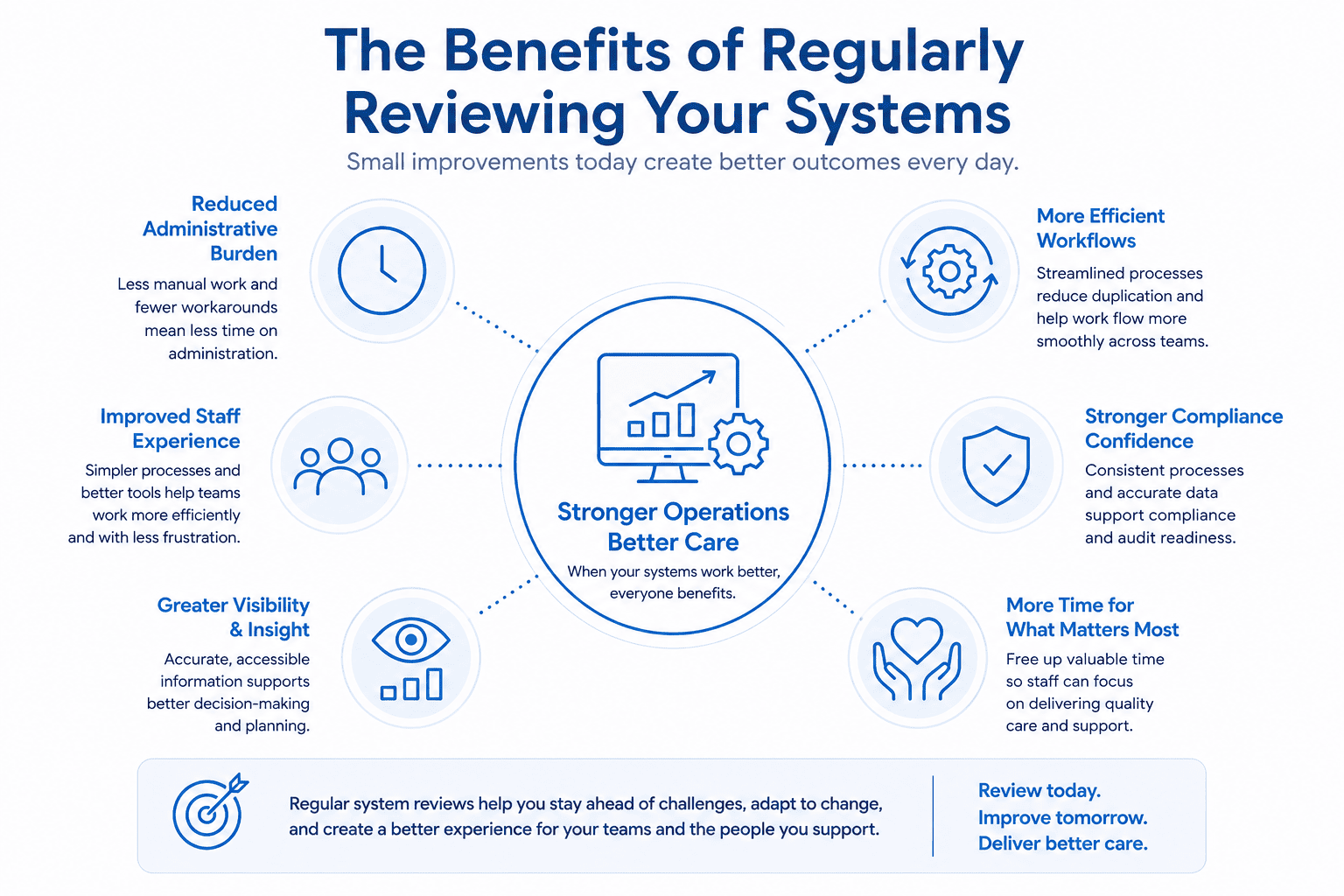
What’s difficult for healthcare providers is that operational requirements rarely stand still. Compliance obligations change, workforce expectations evolve and expectations around care increase. Systems that were well suited in the past may not be as effective today.
This creates hidden risk. Organisations may continue investing time and effort into processes that no longer provide the same value they once did. The longer these systems remain unchanged, the more they hinder efficiency.
While the initial cost of change can be significant, the long-term benefits often far outweigh the upfront investment. Once organisations adopt a mindset of continuous improvement, regularly reviewing systems and processes becomes far less disruptive and more manageable over time.
Technology Should Reduce Complexity, Not Create It
Technology has transformed healthcare operations. However, introducing more technology does not automatically create more efficient organisations. In many cases, adding technology simply creates confusion, complexity, and more work. The focus should be on holistic, singular systems that integrate well with external platforms.
In many cases, new systems are implemented to solve specific challenges without considering how they fit within existing processes and operations. Over time, this can result in organisations managing multiple systems and disconnected processes that add unnecessary complexity to everyday tasks.
As part of a healthcare system review, organisations should assess whether technology is simplifying day-to-day operations or creating additional steps. The most effective systems reduce manual effort, improve access to information, and support more connected ways of working.
As healthcare continues evolving, organisations should expect technology to continue making day-to-day operations more efficient. With technology continually improving, organisations must regularly assess whether there is a better way to operate.
| The best way to reduce administrative workload is to simplify and consolidate systems
Supporting More Connected Workflows at VCare
At VCare, we believe technology should support healthcare providers, not work against them. Our industry leading software simplifies operations rather than adding extra navigation and additional steps.
Our platform supports more connected workflows and streamlined processes. This allows providers to spend less time managing information and more time focused on care.
See How VCare Simplifies Healthcare Workflows: