
Governance is Not A Checklist. It is an Organisational Culture.
| 5 Min Read |
Compliance in New Zealand is Evolving
Healthcare providers across New Zealand are operating in an environment where accountability, quality assurance, and organisational oversight are under increasing scrutiny. As expectations continue to evolve, governance is becoming less about documentation and more about demonstrating that systems and processes are working effectively in practice.
Governance is More Than Policies & Procedures
A common misconception is that good governance is having the documentation to demonstrate compliance and the policies required to support best practice. While documentation plays an important role, governance is not measured by what is written down. It is measured by how effectively standards are embedded into everyday operations.
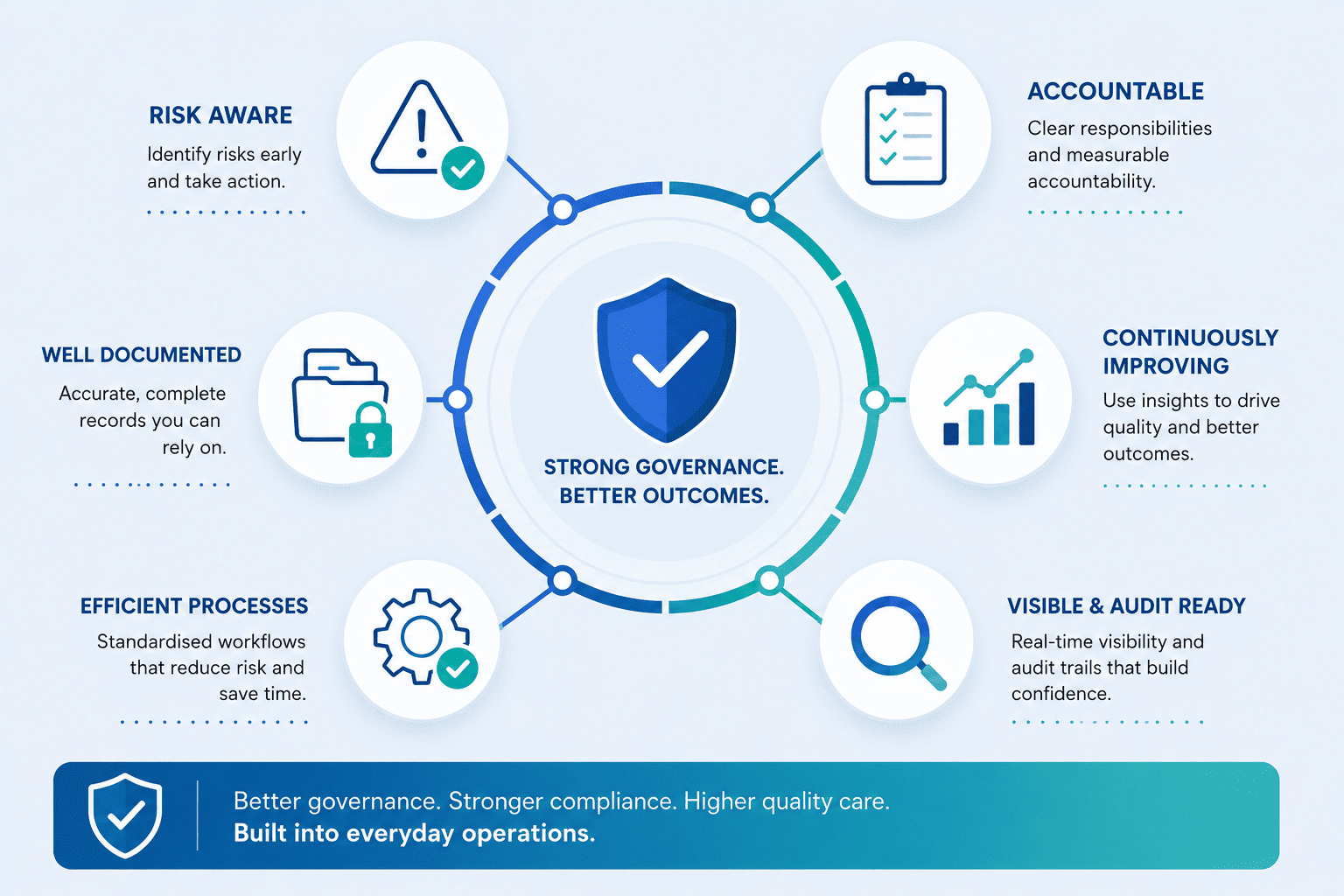
Good governance provides organisations with confidence that processes are being followed, responsibilities are understood, risks are actively managed, and quality outcomes are consistently monitored. Not just on paper, but in practice.
Good governance bridges the gap between policy and practice, ensuring compliance becomes part of daily operations rather than a periodic exercise undertaken in preparation for an audit.
| Good governance is not measured by what is documented. It is measured by how effectively standards are embedded into everyday operations.
Strong Governance. Better Outcomes
Where Providers in New Zealand are Falling Short
As expectations around governance, accountability, and quality continue to evolve, healthcare providers face increasing pressure to demonstrate that their systems and processes are functioning effectively in practice.
Recent Health NZ audits highlighted several areas of concern, which are relevant to providers across New Zealand:
- Risk Management & Quality Systems
- Staffing & Workforce Oversight
- Documentation & Assessments
- Incident & Adverse Event Management
- Auditability & Accountability
- Policy Implementation
While these areas may appear distinct, they share a common theme. Many organisations have policies and procedures in place but struggle to maintain consistent oversight, demonstrate accountability, and translate governance frameworks into day-to-day operations.
These findings reinforce the growing importance of visibility, consistency, and continuous improvement. Providers that regularly review their governance processes and actively address areas of risk are better positioned to strengthen compliance, improve organisational oversight, and deliver high-quality care.
Common Governance Challenges in Healthcare
Many healthcare providers have well-developed policies and procedures in place. However, maintaining effective oversight across services can become increasingly difficult as organisations grow, teams expand, and information becomes distributed across multiple systems.
Information spread in multiple systems, manual processes, inconsistent recording and limited visibility make it difficult to identify emerging risks, monitor performance and demonstrate accountability.
These challenges often result in organisations reactively preparing for audits, rather than proactively improving their systems and processes to embed compliance throughout workflows.
Effective governance requires more than collecting information. It requires the ability to access, analyse, and act on that information in a timely and consistent manner. This highlights the importance of visibility of operations and the collection and display of data in meaningful ways, such as insightful dashboards.
| You can’t manage risks you can’t see, and you can’t improve processes you don’t understand.
Embedding Governance into Everyday Workflows
Strong governance is not the result of a last-minute effort before an audit. It is built through consistent service delivery, clear accountability, and reliable processes embedded into everyday operations.
Organisations that integrate governance into their daily workflows are better positioned to identify risks early, support continuous improvement, and demonstrate compliance when required.
As expectations around governance and healthcare compliance continue to evolve, providers that prioritise visibility, accountability, and operational oversight will be better equipped to manage risk, strengthen compliance, and deliver safe, high-quality care.
Supporting Better Governance at VCare
Many governance challenges faced by healthcare providers stem from fragmented information, inconsistent processes, and limited visibility across operations.
At VCare, we believe technology should support healthcare providers, not work against them. Our platform centralises key information and governance activities such as internal audits, compliance monitoring and operational oversight.
We bridge the gap between detailed records and operational oversight through a range of detailed dashboards, giving leaders real-time insight into operations at any time.
Rather than relying on multiple systems and manual administration, organisations can gain greater confidence that governance processes are being followed, risks are being identified and important information is visible when it is needed.