
How Fragmented Healthcare Systems Increase Administrative Burden
Healthcare Complexity Is Increasing Faster Than Healthcare Workflows
Healthcare is becoming increasingly complex.
Staffing pressure, growing compliance requirements, and rising expectations across the sector are placing significant strain on healthcare providers. A recent Health New Zealand publication highlighted this challenge, noting that workforce pressure and overly rigid regulatory settings can make it harder for healthcare professionals to deliver safe, high-quality care.
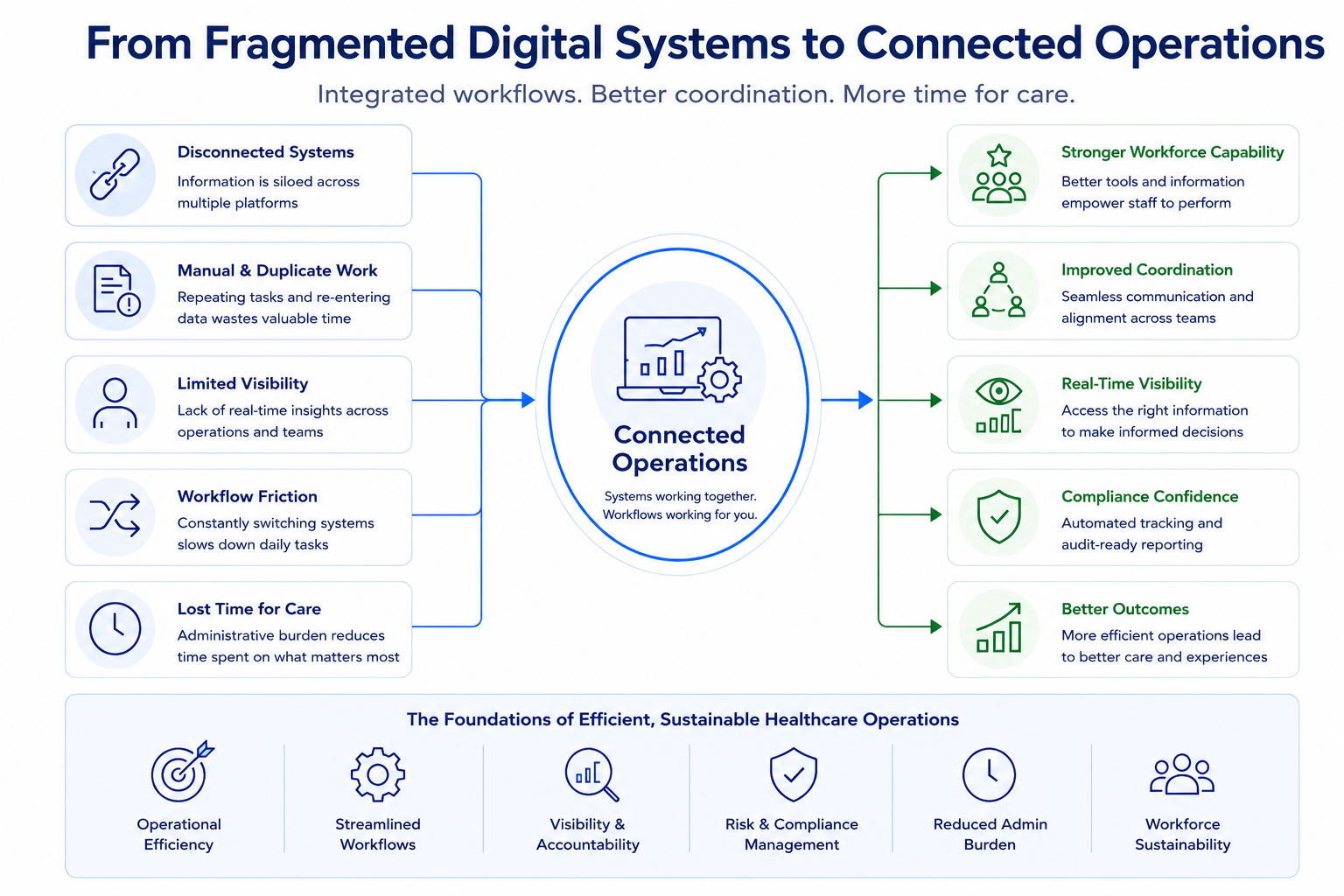
Alongside these operational pressures, the digital systems healthcare workers rely on are also becoming more complex. More features, more navigation, and increasing amounts of duplicated effort are creating fragmented workflows.
While each individual inefficiency may appear small, the combined impact across staffing, compliance, and care coordination workflows can be significant.
| The challenge in healthcare is no longer simply adopting more technology, but ensuring systems and workflows work together effectively.
Fragmented Systems Create Hidden Operational Inefficiencies
Healthcare organisations increasingly rely on digital platforms to manage staffing, compliance, care coordination and reporting. While digital transformation has created significant opportunities across the sector, many providers are still operating across multiple fragmented systems.
In practice, small inefficiencies across may not appear significant individually. However, when repeated across an entire organisation, these inefficiencies can accumulate quickly and create substantial administrative burden.
Healthcare staff often experience the impact of fragmented digital systems through everyday operational inefficiencies such as:
- Duplicate data entry
- Navigating between multiple systems
- Manual handling of data
- Limited Visibility of operations
- Repeated documentation
- Increased administrative overhead
In many healthcare environments, the challenge is no longer simply adopting more technology, but identifying systems that create more connected and manageable operational workflows.
Administrative Burden Is Increasing Pressure on Healthcare Staff
Healthcare professionals are managing increasing administrative demands as compliance, reporting, and documentation requirements continue to grow across the sector.
A recent Stuff NZ article also highlighted growing concern across the profession that nursing workflows are becoming increasingly focused on documentation and administrative processes, rather than time spent delivering care directly to patients. The article highlighted a common frustration shared in the industry that with growing compliance and required documentation, most information filed never is looked at again.
Healthcare Providers Are Prioritising Workflow Consolidation
76%
of New Zealanders believe the healthcare system is overstretched.
Technology Should Reduce Complexity, Not Create It
Healthcare complexity will continue to increase as compliance requirements, operational demands, and workforce pressures continue evolving across the sector. This puts further emphasis moving away from fragmented healthcare systems towards more connected and holistic platforms.
As healthcare organisations assess how effectively their systems support day-to-day operations, many providers are increasingly prioritising:
- Reduced duplication across operations
- Stronger interoperability of systems
- Simplified compliance and reporting
- Reduced administrative burden for frontline staff
- Better integration across operational platforms
- More efficient and sustainable workflows
Ensuring systems are aligned with the practical workflows of frontline staff can play a significant role in creating more connected, responsive, and sustainable healthcare environments.
Technology should support frontline teams by simplifying coordination, reducing duplication, and improving the flow of information across operations. Connected workflows, strong interoperability, and integration with external systems are increasingly becoming characteristics of more effective healthcare operating environments.
| Healthcare organisations are increasingly recognising that disconnected workflows create operational inefficiencies that extend far beyond administration alone.
Supporting More Connected Workflows at VCare
At VCare, we support healthcare providers with connected operational workflows designed to improve coordination, reduce administrative complexity, and give frontline teams clear access to key information.
Our platform integrates with a range of commonly used healthcare applications to help create more connected operational environments across staffing, compliance, care coordination, and reporting workflows. With over 20 years of experience working alongside aged care providers, we understand the importance of systems that simplify operations rather than add to them.
Discover how VCare supports more connected healthcare operations: